News

Which Parts Form a Disaster Relief Tent? Frame, Cover, and Insulation

2026-11-18 0 Leave me a message

When a shelter site opens after a flood or earthquake, the space must go up within hours. A tent holding people for days in sun, wind and rain combines a pole frame, outer fabric, optional insulated liner and fixing hardware. Tangshan Pengcheng Outdoor Products Co., Ltd. breaks down how the parts of a disaster relief tent connect through workshop photos.

The Galvanized Pole Frame Holds Together With Lashing Nodes

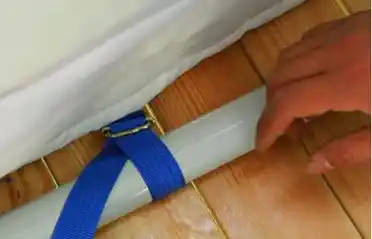
The frame carries the whole load. Poles are rust-proof galvanized round steel tubing; joints are not welded on site. Webbing straps pass around the tubing, through a metal D-ring and knot tight so poles meet flush at each node. Poles bundle separately for transport and are assembled on location by two or three workers; guy ropes and pegs hold the shell down.

Fig.1: A blue webbing strap passes through a metal D-ring to lash galvanized poles at the joint

Double-Stitched Outer Fabric and the Window Mesh Fixing

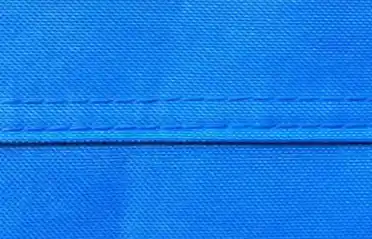
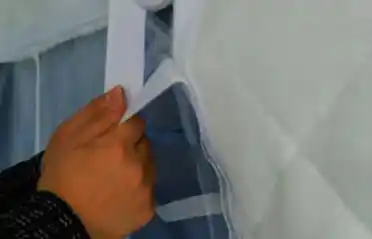
The outer fabric sheds rain, wind and sun. Panels are double-stitched at even spacing, seams pressed tight so water cannot track through needle holes. Window openings are bound before a lattice mesh window is sewn in; the mesh edge is fixed by white webbing through loops and closes with hook-and-loop strips.

Fig.2: Close-up of double stitching between blue fabric panels

Fig.3: White webbing passes through a fabric loop to fix the mesh edge

Quilted Cotton Liner Fitted Inside the Frame

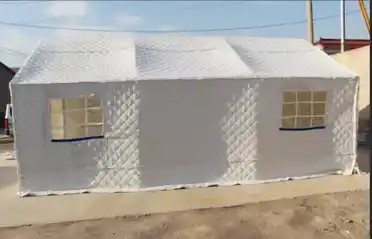
Cotton models add a quilted liner inside the frame. A diamond quilting pattern locks the filling so batting cannot shift; a pole passes through a sewn sleeve and is lashed, seating the liner against the frame with an air gap to the outer fabric. In cold seasons this layer slows heat loss; for a disaster relief tent in winter camps it keeps the shell livable.

Fig.4: A pole passes through a quilted liner sleeve and is lashed in place

Two Finished Looks: Blue Civil-Affairs Model and White Cotton Model

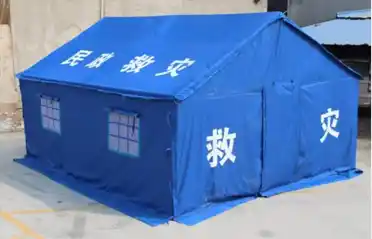
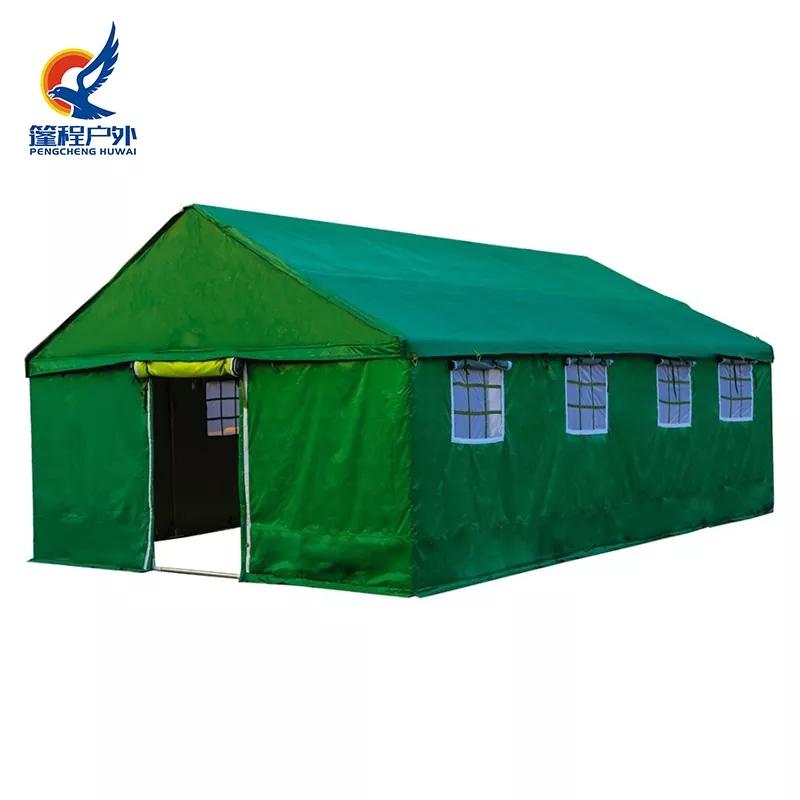
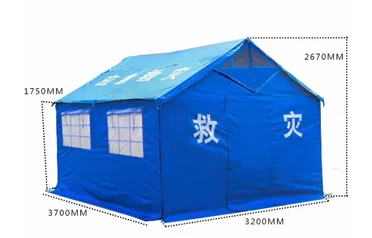
The blue civil-affairs model carries white lettering, lattice mesh windows and a blue skirt wall for emergency housing and storage; the white cotton model is quilted with daylight windows for long cold stays.

Fig.5: Finished blue civil-affairs relief tent with white lettering

Fig.6: Finished white quilted cotton tent with lattice windows

Pre-Dispatch Structural Inspection and the Governing Standard

Finished tents pass batch sampling inspection before dispatch: pole-wall thickness, webbing and hardware, sewing quality and quilting density are checked, with faulty batches reworked separately. Production follows GB/T 44010-2024, General Technical Requirements for Disaster Relief Tents.


About Tangshan Pengcheng Outdoor Products Co., Ltd.

Founded in 1997 in Yahongqiao Town, Yutian County, Tangshan, Hebei, the company runs a 15,000-square-meter base, holds ISO9001 and ISO14001 certifications, and is a National High-Tech Enterprise and Hebei SRDI SME. It donated tents after the 2008 Wenchuan earthquake and 2020 epidemic response.Frequently Asked QuestionsQ: Is the relief tent frame welded or lashed?

A: Field-assembly models use galvanized poles with webbing and metal buckles, so the bundle travels flat and goes up on site; welded frames belong to fixed structures.

Q: How do I choose between a single-wall and a cotton model?

A: Single-wall for warm seasons and high ventilation; quilted cotton for cold seasons and long stays. State the season when ordering.

Q: Which standard does the product follow?

A: GB/T 44010-2024 General Technical Requirements for Disaster Relief Tents, with batch sampling inspection; buyers can name this standard in the acceptance clause.

Q: Which structural points should I check on purchase?

A: Pole wall thickness and galvanizing, lashing-node webbing and rings, double-stitched seams, mesh-loop fixing, and quilting density, counted against the spec sheet.

From the lashing nodes of the galvanized frame to the double-stitched seams and quilted liner, the habitability of a disaster relief tent rests on these details. Buyers can request structural photos and a spec sheet before ordering.


Related News
Leave me a message
X
We use cookies to offer you a better browsing experience, analyze site traffic and personalize content. By using this site, you agree to our use of cookies. Privacy Policy
RejectAccept